


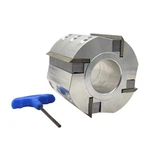
CNC Milling Cutter
Why Choose Dongguan Kangmingjian Tool Co., Ltd.?
Dongguan Kangmingjian Tool Co., Ltd. was established in 2004 and is committed to providing customers with competitive, high-quality products and services. Since its establishment, the company has had a good environment for modern innovation capabilities. It is this environment that allows the company to develop rapidly.
Quality Assurance
Each batch of goods has a corresponding quality inspection report to solve your concerns about product quality.
Delivery On Time
We cooperate with professional sea shipping, air and logistics companies to provide you with the best transportation solution to ensure timely delivery of goods.
Wide Product Range
Our company seizes market opportunities and develops a series of practical products, technologies and solutions. The product categories continue to increase, the scope of the market network continues to expand, and it has gained wide market recognition and domestic and foreign market shares. The tool series produced by the company includes woodworking tools, woodworking milling cutters, spiral cutters, woodworking drill bits, alloy row drill bits, diamond tools, circular saw blades and a series of tool products for woodworking.
Professional Technical Team
The company has a group of engineering and technical talents with rich experience in producing woodworking tools. They use ultra-fine grain tungsten steel materials, CAD, 3D design, advanced turning and milling compound machine tools, and five-axis linkage grinder production processes to ensure the use of each tool. The company accepts customers' drawings and samples for customized production.


What is CNC Milling Cutter?
A CNC milling cutter is a cutting tool that is used in computer numerical controlled (CNC) machining. A milling cutter is an essential component of a milling machine. As the name suggests, it’s the cutting tool that’s responsible for scraping material out of a workpiece. All milling machines have a cutter. During a typical milling operation, the cutter moves perpendicular to its axis, allowing it to remove material from the workpiece on the circumference of the cutter.
This type of cutter is typically made from high-speed steel or carbide and is designed to create precise cuts on various materials, including metal, plastics, and wood. The cutter is attached to the spindle of the CNC machine and moves along multiple axes to create the desired shape or feature. There are various types of CNC milling cutters, including end mills, ball nose mills, face mills, and more, each designed for specific applications and materials.
1. High Precision:
CNC milling cutters offer a high and consistent level of precision, delivering highly accurate, repeatable results.
2. Versatility:
The use of CNC technology means that these milling cutters are highly versatile, allowing them to cut a wide variety of materials, including metals, plastics, and composites.
3. Speed and Efficiency:
CNC milling cutters work quickly, efficiently, and with high accuracy, achieving results that can be unparalleled when compared to traditional manual milling processes.
4. High Levels of Automation:
These milling cutters use advanced software and automation systems allowing them to run uninterrupted for long periods while producing highly consistent and accurate output.
5. Improved Safety:
Using CNC milling cutters reduces the risk of injury and workplace accidents since the machine operator doesn't have to interact directly with the cutting tools.
6. Customization Capabilities:
CNC milling cutters can be programmed to produce complex and often intricate shapes, making them ideal for custom part manufacturing.
7. Reduced Costs:
CNC milling cutters can optimize material usage and reduce scrap by maximizing the number of parts that can be produced from a single workpiece, leading to cost savings for the manufacturer.

Types of CNC Milling Cutter
|
Different Purpose |
Different Materials |
|
End Mill Cutters End mill tools are mill-cutting tools that cut in all directions, making them quite different from drill tools that cut only axially. Manufacturers use the end mill for tool steel cutting and other milling processes, including plunging, reaming, slotting, drilling, face milling, profile milling, etc. There are common types of end mill cutters.
Face Milling Tool This tool is used for face milling. So what is face milling? It is the removal of portions of a workpiece. A face milling tool is used to achieve an excellent surface finish. At the sides of this tool, it has cutting edges that cut in a horizontal direction, as opposed to end mills that cut vertically. Also, a face mill tool is mainly used to cut the outside of the blank.
T-Slot Cutters T-slot cutters feature teeth that are perpendicular to the outside diameter. Also known as woodruff cutters, these cutters are best known for cutting T-shaped slots into parts and workpieces. These types of milling cutters are ideal for cutting slots used for bolt heads and hanging brackets in wall panels.
Twist Drills Twist drills are the most popular tools for making holes.
Thread Mills Thread mills are the masters of cutting process of creating internal threads in workpieces. These specialty tools come in three types: roll form taps, cut taps, and thread mills. These types are employed on numerically controlled machining centers that are equipped with simultaneous, triaxial control, and helical interpolation features.
Metal Slitting Saw Cutter Tool These saws have applications across various industries due to their unique geometry and rigidity. However, industries like the automotive, precision engineering and construction industries commonly use them to cut non-ferrous and steel materials. Here are the different types of metal slitting saw cutters.
Fly Cutters These milling tool plane surfaces use one or more single-point rotary tools. Similar to the lathe-cutting tool, manufacturers mount a fly-cutter tool on a special holder. It is also important to note that fly cutters are not ideal for heavy-duty cutting operations. Below are the different types of flyer cutters.
Form Milling Cutters This is a cutter used for shaping irregular contours, both 2D and 3D. These cutters also come in different configurations and shapes. It is ideal for creating helical gears and other complex and intricate surfaces. It is used for groove, chamfering, and full-radius milling. There are three major types of form milling cutters. |
Carbon Steel Carbon steel is the most economical material used for milling cutters, suitable for low-speed operations. This material is often found in various tools such as milling cutters and twist drills. However, carbon steel is not suitable for high-speed operations or cutting hard materials due to its limited durability and low melting point.
While carbon steel is an inexpensive option, it is important to consider its limitations. For projects requiring higher speed or toughness, other materials such as high-speed steel or carbide may be more suitable.
High-Speed Steel (HSS) High-speed steel (HSS) is a game-changer in the world of milling cutters. HSS is made up of chromium, tungsten, and molybdenum. It offers greater hardness, toughness, and durability compared to conventional carbon steel. This material is suitable for cutting both ferrous and nonferrous metals, with a higher resistance to heat and wear.
Due to its enhanced properties, high-speed steel is ideal for milling tools required to operate at higher speeds and cut harder materials. With HSS, you can ensure longer tool life and greater efficiency in your machining operations.
Carbide Carbide, more properly known as Tungsten Carbide, is the heavyweight champion of CNC milling tool materials. This highly resistant material is ideal for high-quality surface finishes in newer milling machines. Carbide is a combination of carbon and tungsten, forming a chemical compound that offers superior resistance to wear compared to HSS.
If you’re looking for a milling tool material that can withstand the toughest of projects, carbide is the way to go. Its resistance to wear, coupled with its ability to produce high-quality finishes, makes it a popular choice among CNC milling professionals. |

Benefits of CNC Milling Cutter
Durability
CNC Milling Cutter have greater durability. They are resistant to cracking and abrasion and can cut through most debris in material without sustaining damage. Even tough materials such as bullets, screws and nails may be easily cut.
Precision
CNC Milling Cutter is ideal for precision work. You achieve superior performance when aiming for either finished or surface finished quality. The tooltips stay sharper for longer and CNC Milling Cutter blades can cut faster without binding, thus reducing the workload on machines.
Better Fit
They retain their precise cutting edge and hold a longer shelf life. Their sharp edge creates straight and clean cuts with minimal damage, resulting in better material fit and tighter bonds.
High Efficiency
CNC milling cutters can endure both high temperature and high cutting speed. This means that tools require less frequent sharpening, increasing your work efficiency.
Cost-Effective
Tool quality and longevity far exceed the price paid, so CNC Milling Cutter is highly cost-effective. A well-cared-for CNC Milling Cutter can last 20+ years.
Application of CNC Milling Cutter
Plain Milling
Also known as surface milling, this milling process uses a cutting tool to remove material along the surface of the workpiece. In plain milling, the rotation axis is parallel to the workpiece.
Face Milling
Face milling uses a rotational axis perpendicular to the material’s surface. The cutting or grinding tool faces down against the workpiece surface to remove material.
Angular Milling
This milling method positions the cutting tool’s rotary axis at an angle to the workpiece surface to produce angular cuts as specified by the design, such as grooves or dovetails.
Form Milling
Form milling makes non-flat cuts, such as contours and curves. Each type of curve will require a specific cutting tool to create an accurate form cut.

How to Choose CNC Milling Cutter
Milling Cutter Size and Diameter
The milling depth and width determine the size of the mill cutting tools. An increase in width and depth before mill tooling means an increase in the size of the milling cutter. However, Φ16~Φ630mm is the standard index milling cutter diameter range.
When milling parts with a large surface area, the recommendation is to use milling cutters with smaller diameters. Ideally, during any milling operation, 70% of the cutter’s cutting edges should take part in cutting.
Another factor that can determine the diameter of the milling cutter is the diameter of the machine tool spindle. The recommendation for selecting a face milling tool diameter is D = 1.5d, where d is the spindle diameter.
Also, when milling holes, the size of the tool also requires great attention because if the milling cutter diameter is too large or too small compared to the hole, it could cause damage to the workpiece or tool.
Milling Cutter Power
When selecting the right milling cutter, the major factors to consider are cutting power and workpiece processing size. For instance, when selecting the diameter of a face mill cutting tool, the power requirement of the tool should be within the power range of the milling machine cutting tool.
In addition, for a small diameter end mill, the machine’s maximum revolution meeting the minimum tool cutting speed (60m/min) should be the main consideration.
Selection of Milling Tool Body
When choosing a milling tool, the number of teeth on the tool is an important consideration. A dense-tooth milling tool can have 8 teeth with a diameter of 100mm, while a coarse-tooth tool with the same diameter has only 6 teeth. Coarse metal milling tools are ideal for rough machining due to their large chip flute, which reduces friction between the workpiece, cutter body, and the chip itself.
Besides, it is important to note that a dense-toothed milling tool’s cutting load per tooth is smaller than that of a coarse-toothed milling tool at an equal feed rate.
Selection of Milling Tool Blade
Using a grinding blade is the best option for fine milling tooling. This type of insert provides improved dimensional precision while increasing the placement accuracy of the cutting edge during milling, allowing for better surface roughness and machining accuracy. However, it is preferable to utilize a pressed blade for roughing because it can lower the cost of processing.
Moreover, using carbide inserts without sharp rake angles would reduce the tool service life, especially with small cutting depths and small feeds.
How to maintain CNC Milling Cutter

Tool Coatings for Enhanced Performance
A masterpiece requires not only the right canvas, but also the right paint. Tool coatings play a vital role in enhancing the performance and durability of CNC milling tools. By improving the properties of the tools and helping them withstand high temperatures, coatings such as titanium nitride (TiN), titanium carbo nitride (TiCN), aluminum titanium nitride (AlTiN), and diamond-like carbon pave the way for flawless machining operations.
Let’s take a closer look at these common coatings, and discover how they can elevate the performance of your milling cutters.

Titanium Nitride (TiN)
Titanium nitride (TiN) is a popular coating used to increase the hardness and thermal stability of cutting tools. This golden coating was once the go-to choice for milling tools, but its use has waned with the introduction of newer coatings that offer better properties.
While titanium nitride may not be the most cutting-edge tool coating available today, it still plays a role in enhancing tool performance. In particular, TiN coatings can extend tool life, reduce adherence to workpieces, and improve hardness.

Chromium Nitride
Chromium nitride is an underdog in the world of tool coatings. This hard, inert, thin film coating enhances hardness, corrosion resistance, and thermal strength for high heat applications. However, chromium nitride coatings can be costly and require specialized equipment for application.
Despite its drawbacks, chromium nitride offers significant benefits for certain machining tools and operations. If your project demands a tool with high heat resistance and corrosion protection, chromium nitride may be the perfect coating for the job.

Aluminum Titanium Nitride (AlTiN)
Aluminum titanium nitride (AlTiN) is a rising star in the realm of machine tool coatings. Composed of 65% aluminum, AlTiN enhances the heat resistance of CNC machine tools, making it an ideal choice for high-temperature operations. This coating offers increased heat resistance, enhanced wear resistance, and improved oxidation resistance compared to other coatings.
With its unique combination of properties, AlTiN is a valuable addition to any CNC milling tool arsenal. Equip your tools with this powerful coating, and watch your machining operations reach new heights of performance.

Our Factory
We have a complete factory production, quality supervision and delivery.
Our Certificate
At present, we have obtained the following certificates.

Ultimate FAQ Guide to CNC Milling Cutter
Q: 1. What is a CNC milling cutter?
Q: 2. How does a CNC milling cutter work?
Q: 3. What is the difference between a CNC milling cutter and a conventional milling cutter?
Q: 4. What materials can be milled with a CNC milling cutter?
Q: 5. What are the different types of CNC milling cutters?
Q: 6. What is the purpose of an end mill?
Q: 7. What is the purpose of a ball nose mill?
Q: 8. How can you minimize tool wear and breakage when using a CNC milling cutter?
Q: 9. What is the purpose of a face mill?
Q: 10. What is the purpose of a thread mill?
Q: 11. What is the difference between a solid carbide milling cutter and a high-speed steel milling cutter?
Q: 12. What is the difference between an upcut milling cutter and a downcut milling cutter?
Q: 13. What is the difference between a left-hand milling cutter and a right-hand milling cutter?
Q: 14. How do you choose the right CNC milling cutter for your project?
Q: 15. What are some tips for maintaining and caring for your CNC milling cutter?
Q: 16. Can a CNC milling cutter be resharpened?
Q: 17. How long does a CNC milling cutter last?
Q: 18. What is the maximum cutting speed for a CNC milling cutter?
Q: 19. What are some common problems that can occur when using a CNC milling cutter?
Q: 20. How can you reduce chip buildup when using a CNC milling cutter?