


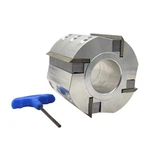
Spiral Cutter Shaft For Woodworking
Why Choose Dongguan Kangmingjian Tool Co., Ltd.?
Dongguan Kangmingjian Tool Co., Ltd. was established in 2004 and is committed to providing customers with competitive, high-quality products and services. Since its establishment, the company has had a good environment for modern innovation capabilities. It is this environment that allows the company to develop rapidly.
Quality Assurance
Each batch of goods has a corresponding quality inspection report to solve your concerns about product quality.
Delivery On Time
We cooperate with professional sea shipping, air and logistics companies to provide you with the best transportation solution to ensure timely delivery of goods.
Wide Product Range
Our company seizes market opportunities and develops a series of practical products, technologies and solutions. The product categories continue to increase, the scope of the market network continues to expand, and it has gained wide market recognition and domestic and foreign market shares. The tool series produced by the company includes woodworking tools, woodworking milling cutters, spiral cutters, woodworking drill bits, alloy row drill bits, diamond tools, circular saw blades and a series of tool products for woodworking.
Professional Technical Team
The company has a group of engineering and technical talents with rich experience in producing woodworking tools. They use ultra-fine grain tungsten steel materials, CAD, 3D design, advanced turning and milling compound machine tools, and five-axis linkage grinder production processes to ensure the use of each tool. The company accepts customers' drawings and samples for customized production.


What are Spiral Cutter Heads?
A spiral cutter head consists of a cylindrical shaft with several rows of small carbide insert knives arranged in a spiral pattern around the shaft. Unlike traditional straight cutterhead, these small inserts contact the wood board continuously, reducing tear-out and creating a consistent and smooth cut. Tungsten carbide is the second hardest material in the world, so these insert knives feature an extended service life and low maintenance. Spiral cutter heads are more suitable for low-density wood.
1. Versatile Cutting Capability: A spiral cutter head can perform different types of cutting, including rabbeting, grooving, and shaping.
2. Reduced Noise and Vibration: Spiral cutter heads produce less noise and vibration during operation, making them more comfortable to use.
3. Cleaner Cuts: The spiral design of the cutter head produces cleaner cuts, with little or no tear-out or chipping.
4. Longer Tool Life: The spiral layout of the cutter head distributes cutting forces evenly, reducing wear and tear on the blades and extending their lifespan.
5. Faster Cutting Speed: The spiral design of the cutter head allows for a more aggressive cutting action, resulting in faster material removal and less time spent on each cut.
6. Less Power Required: Due to the efficient cutting action of the spiral cutter head, less power is needed to achieve the same results compared to traditional cutter heads.
7. Easy Maintenance: Spiral cutter heads are relatively easy to maintain, with replaceable blades that can be quickly swapped out when they become dull or damaged.
8. Compatibility with Multiple Machines: Spiral cutter heads can be used with a variety of machines, including planers, jointers, and moulders, making them a versatile choice for woodworking professionals.
9. Improved Surface Finish: The spiral cutter head produces smoother and more uniform surface finishes on the material, making them ideal for high-end applications that require precise and consistent results.
10. Greater Safety: The reduced noise and vibration levels of the spiral cutter head make them safer to use, and the efficient cutting action reduces the risk of kickbacks or other accidents.

Spiral VS Helical Cutterhead
1. Blade Arrangement
Spiral cutter heads have multiple blades that are placed around a central shaft. The spiral cutter head blades are straight positioned in a spiral around the shaft. On the other hand, helical cutter head blades are positioned in an angled manner so that they form a helix around the shaft.
2. Structure
The spacing between the blade is uniform except at the leading edge where it extends closer to support the material being cut.
Helical cutterheads have a uniform spacing along the entire length of the blade. It starts out close to support materials and then gradually becomes wider at the leading edge.
3. Application
Spiral cutter heads have primary applications in areas where there is a need to cut soft, low-density materials. Helical cutters are more suited for cutting high-density materials since they are blunt on the leading edge.
4. Durability
Both types are quite durable. However, spiral blades have a longer blade life and can withstand more wear and tear. The helical head type, on the other hand, is slightly less durable than the spiral head type.
5. Cutting Action
Helical cutters can be used for deep holes, but spiral cutters cannot. Spiral cutter heads use a lead screw to drive the blades in an inward motion against the material to be cut. This is what generates revolutions and provides lift as it cuts through the material. The result is a clean cut with no tear-out.
Helical cutters use a rhombus-shaped blade to drive the material in an outward motion against the wall of the hole being made. This is what generates revolutions and provides lift (and therefore speed) as it cuts through the material. The result is also a clean cut with no tear-out, but it may be necessary to drill a pilot hole first.
6. Tolerances
Spiral cutters are not as accurate as helical cutterheads.
Helical cutters are best for fine detail work or when making moulds of existing parts or patterns that need to be reproduced accurately. This is because they have the ability to cut right up to the edges of a mould or pattern without damaging it.
They are also more accurate compared with spiral cutters which often need support blocks for added strength at the edge of the material being cut.
7. Productivity
Spiral cutters are less productive compared with helical cutterheads.
Helical cutterheads are faster because they have the capability to make deep cuts in material while removing less of the material being cut.
They also leave a smooth finish, which can lead to increased production speeds when producing parts or patterns repeatedly for the same job.
8. Pressure Reliefs
Spiral cutters produce a shearing action on the material being cut. This can lead to a build-up of pressure at the cutting surface which causes friction, burn marks and blade wear.
Helical cutterheads have more contact points with the material being cut compared with spiral cutters, so they give better support for the material, preventing pressure build-up and leaving more space for the material to expand. This leads to superior finishes on parts, which also means less rework during production.
9. Load-Carrying Capacity
Spiral cutter heads have a greater load-carrying capacity compared with helical cutters because they have more contact points, which means fewer blades are needed to cut deep holes.
Helical cutterheads have fewer contact points than spiral cutters but far more than an end mill or a router bit, so even though each cutting edge works harder, it’s still less than with spiral cutters.
10. Tool Life
Spiral cutter heads have longer blade life compared with helical cutters because the blades are arranged in a helix that is closer to the centre of rotation. This gives them more support and prevents flexing at the cutting edge.
A helical cutterhead has a greater tool life, but not as much as a spiral cutter, since each blade contains multiple cutting edges, which are arranged in a helix to provide a better geometry for ensuring smooth cutting.
11. Installation Considerations
Spiral cutter heads have to be mounted on a swivel or pivot bench which enables them to follow the contour of the material being machined. Spiral cutters can be found on benchtop jointer, benchtop planer, benchtop router, etc.
Helical cutters can be mounted in a vice which is faster and more convenient for setups, but benchtop swivelling units are available for this purpose as well.
12. Maintenance
Helical cutterheads are easier to clean and maintain since there is no leading edge. Spiral cutter heads have a blunt edge that helps support the material being cut but leaves room for debris build-up during use. This makes them more difficult to clean out, which can cause problems if not done on a regular basis.
Helical cutters are also much stronger than spiral cutters because they have blades that interlock for stability, giving them an edge when it comes to cutting deep holes in dense material. This may not be the case with spiral cutters. However, their structure makes them more flexible which guarantees a smoother finish.

Benefits of Spiral Cutter Heads
Edge Longevity.
Spiral cutter heads utilize carbide steel inserts, while most knife-based cutter heads incorporate knives made of high-speed steel. Carbide normally holds an edge for at least three times as long as high-speed steel, much longer than that in many cases. This translates to less time between swapping out cutters. Plus, the insert cutters for spiral cutter heads normally have four cutting edges on each one, so if one gets dull, it can be rotated, and the jointer is immediately back in production. Depending upon the cost of sharpening and replacing knives in your area, it is unlikely that this longevity advantage alone will ever singlehandedly justify the cost of the spiral cutter upgrade. Still, it is a factor that can offset some of the price differentials, so it is worth consideration.
Super Easy Cutter Changes.
Depending upon the design of a given cutter head, swapping out knives can be a cumbersome, time-consuming process. With spiral cutter heads, the process could not be much simpler. Remove one screw, rotate the cutter 90 degrees to a new edge, tighten it down, and resume jointing.
Setting Knives can be Frustrating.
This can take a while and lead to inconsistent results in getting the knives consistently set to the perfect height. Of all the factors to consider with spiral cutter heads, this one appeals to me the most, as I am not a fan of swapping knives in a jointer.
Minimal Disruption from Nicks in Knives.
With high-speed steel knives, if you nick one of your blades, you either have to remove the blades and sharpen the set or try to slide the knives so that the nicked portions of the blade no longer align. This presents either a cost factor, hassle, or both. With spiral cutter heads, you rotate and are back in business. Plus, since the inserts are made of carbide, the likelihood of getting nicks in the cutters goes way down in the first place.
Quieter.
The spiral cutter heads operate much more quietly than knife-based cutter heads. Although I don’t own a sound level meter, I can’t quantify this, but the difference to my ears is pretty dramatic.
Joint MDF or Plywood.
If you ever have a requirement to join man-made materials such as MDF or plywood, you can do this with confidence using a carbide insert cutter head, while this is not recommended with traditional knives (although I will admit that I have jointed plywood with knives a time or two).
Easier Dust Collection.
A minor benefit is that the smaller cutters on spiral cutter heads break the material into smaller pieces, so slightly less suction is required to extract the waste back to a central system.
Application of Spiral Cutter Heads
1. Woodworking: Spiral cutter heads are extensively used in the woodworking industry to shape and cut different types of wood. From planing to shaping, these cutter heads are ideal for cutting both hard and soft woods with ease.
2. Metalworking: Spiral cutter heads are also used in the metalworking industry for cutting and machining different types of metals, including aluminum, brass, and steel. They are particularly useful in high-speed machining applications where precision and accuracy are crucial.
3. Plastic industry: Spiral cutter heads are used in the plastic manufacturing industry for cutting and shaping different types of plastic materials such as PVC, polycarbonate, and acrylic. They are designed to deliver precise cuts and smooth finishes, even in the toughest materials.
4. Foam cutting: Spiral cutter heads are commonly used for cutting foam materials such as polyurethane and expanded polystyrene. They are ideal for cutting intricate designs and shapes with ease, making them an important tool in the foam cutting industry.
5. Printing industry: Spiral cutter heads are also used in the printing industry for cutting and shaping different types of printing plates. With their accuracy and precision, spiral cutter heads help reduce waste and increase productivity in the printing process.

How to Choose Spiral Cutter Heads
In fact, the spiral cutterhead are also divided into different quality standard,the he price of helical planer head of different grades is very much related. Let me introduce to you:
The basic parameters of the spiral cutterhead are: cutting length ( planing width), the diameter of the outer circle of the planer, the number of spiral grooves (the number of rows of the planer), the number of planer blades, and the cutting angle of the planer blade.
It’s easy to understand the cutting length and the outer diameter of the planer cutting , everyone will know how much planing width and diameter of planer shaft to choose by looking at this parameter.
The Number of Spiral Grooves and The Number of Planer Blades
The three parameters of the number of spiral grooves (the number of rows of the planer), the number of planer blades and the cutting angle of the planer blade determine the planing grade and price of the spiral planer. This is the content I focus on.
The number of spiral grooves,for the national standard or European and American standards, the number of spiral grooves is set to 2 wings, 4 wings, 6 wings, 7 wings, 9 wings, 12 wings, 15 wings, 18 wings, 21 wings, 24 wings.,the more wings set on the helical cutterhead of a certain diameter, the more planer blades are arranged, and the better the planing quality. Of course, in certain circumstances, the more grooves, As a result, the diameter of the entire cutter shaft is also larger. In the case of a certain diameter cutter head, of course, the more grooves, the better, and the more blades are arranged, the better.
In the same slot, the more blades arranged, the higher the planing quality, and the higher the overall cost of the shelix cutterhead. Therefore, the planer cutter head of different prices has different numbers of blades on the same slot.
Of course, under certain circumstances, the more grooves, the larger the diameter of the entire cutter head. In the case of a certain diameter cutter head, the more grooves, the better, and the more blades are arranged, the better.
The Cutting Angle of The Planer Edge
The cutting angle of the planer edge, that is the angle between the direction line of the cutting edge of the blade and the planing line of the planer (the angle relationship between the direction line of the cutting edge of the blade and the axis of the knives);It’s an important parameter that is not easy to be found by non-professional woodworking friends. According to the cutting angle of the planer blade, the spiral cutterhead is divided into a flat-cut spiral cutterhead and an oblique-cut spiral cutterhead . These two cutting methods are different, and they also determine the spiral. There is a big difference between the quality of the jointer cutter head and the price, and the price will be multiple.
If there is a certain angle between the cutting edge direction line of the blade and the planing line of the planing table, then this kind of helical cutter head resistance in the planing process is small, the noise is also low, and the quality of the planing is high. However, the manufacturing process is relatively complicated, and the natural cost is high.
If there is a parallel relationship between the cutting edge direction line of the blade and the planing line of the planer, then this helical cutter head resistance during the planing process is greater, and the noise is greater, so its manufacturing The process is relatively simple, and the natural cost is lower. Its planing quality is not as good as that of the planer cutter head.
In terms of table saws and wood lathes, usually mainly planing is flat planing,the size of spiral cutterhead with shaft used should be larger than that of the press planer,you can choose a helical cutterhead with more grooves. If the size is small, you can only choose a spiral cutterhead with a relatively small shaft diameter.
Maintenance of Spiral Cutter Heads
Regular Cleaning:
One of the key maintenance tasks for a spiral cutterhead is regular cleaning for jointers. Chips and debris can accumulate in the cutterhead's spiral design, affecting its cutting efficiency. After each use, remove the cutterhead guard and carefully clean the cutterhead using compressed air or a small brush. Pay special attention to the spaces between the carbide inserts, ensuring all debris is cleared away.
Inspection and Adjustment:
Regularly inspect the carbide inserts on the spiral cutterhead to ensure they are securely in place and in good condition. Check for any signs of wear or damage, such as chips or dullness. If necessary, replace any worn or damaged inserts with new ones from the manufacturer. Additionally, verify that the inserts are aligned properly and at the correct height for optimal cutting performance.
Lubrication:
Proper lubrication is crucial for the smooth operation of a spiral cutterhead. Consult the manufacturer's recommendations for the specific lubricant to use. Apply a small amount of lubricant to the bearings or bushings according to the provided instructions. This will help reduce friction and extend the life of the cutterhead.
Blade Alignment:
If you notice uneven cuts or excessive noise during operation, blade misalignment could be the issue. Check the alignment of the spiral cutterhead blades and adjust if necessary. Most manufacturers provide guidelines for aligning the blades correctly. Follow these instructions carefully to ensure precise and consistent cutting performance.

Our Factory
We have a complete factory production, quality supervision and delivery.
Our Certificate
At present, we have obtained the following certificates.

Ultimate FAQ Guide to Spiral Cutter Heads
Q: 1. What is a spiral cutter head?
Q: 2. What are the advantages of a spiral cutter head?
Q: 3. How many blades are typically found in a spiral cutter head?
Q: 4. How do spiral cutter heads differ from traditional cutter heads?
Q: 5. What are the most common types of spiral cutter heads?
Q: 6. Are spiral cutter heads more expensive than traditional cutter heads?
Q: 7. Can spiral cutter heads be used on any machine?
Q: 8. How often do spiral cutter heads need to be sharpened?
Q: 9. Can spiral cutter heads be resharpened?
Q: 10. How long do spiral cutter heads typically last?
Q: 11. What materials can spiral cutter heads cut through?
Q: 12. Are spiral cutter heads more efficient than traditional cutter heads?
Q: 13. Can spiral cutter heads be used on a jointer?
Q: 14. Can spiral cutter heads be used on a planer?
Q: 15. Can spiral cutter heads be used on a router table?
Q: 16. Do spiral cutter heads require any special maintenance?
Q: 17. Can spiral cutter heads be used on CNC machines?
Q: 18. How does speed affect the performance of spiral cutter heads?
Q: 19. Can spiral cutter heads be used on exotic materials?
Q: 20. How do you know when the blades on a spiral cutter head need to be replaced?