


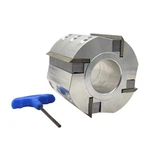
Woodworking Milling Cutter
Why Choose Dongguan Kangmingjian Tool Co., Ltd.?
Dongguan Kangmingjian Tool Co., Ltd. was established in 2004 and is committed to providing customers with competitive, high-quality products and services. Since its establishment, the company has had a good environment for modern innovation capabilities. It is this environment that allows the company to develop rapidly.
Quality Assurance
Each batch of goods has a corresponding quality inspection report to solve your concerns about product quality.
Delivery On Time
We cooperate with professional sea shipping, air and logistics companies to provide you with the best transportation solution to ensure timely delivery of goods.
Wide Product Range
Our company seizes market opportunities and develops a series of practical products, technologies and solutions. The product categories continue to increase, the scope of the market network continues to expand, and it has gained wide market recognition and domestic and foreign market shares. The tool series produced by the company includes woodworking tools, woodworking milling cutters, spiral cutters, woodworking drill bits, alloy row drill bits, diamond tools, circular saw blades and a series of tool products for woodworking.
Professional Technical Team
The company has a group of engineering and technical talents with rich experience in producing woodworking tools. They use ultra-fine grain tungsten steel materials, CAD, 3D design, advanced turning and milling compound machine tools, and five-axis linkage grinder production processes to ensure the use of each tool. The company accepts customers' drawings and samples for customized production.


What is Woodworking Milling Cutter?
Woodworking milling cutters are crucial components of milling machines, serving as the cutting tools used to remove excess material from the workpiece. Each milling machine incorporates a specific cutter for precise machining operations.
Woodworking milling cutters are rotary tools used to shape and remove material from workpieces during machining processes. Woodworking milling cutters are essential in woodworking. Each type of milling cutter is designed to serve specific purposes and achieve precise results. These tools play a crucial role in shaping, grooving, slotting, and contouring workpieces with accuracy and efficiency, from simple end mills to complex form cutters.
Flutes / Teeth: The flutes of the milling bit are the deep helical grooves running up the cutter, while the sharp blade along the edge of the flute is known as the tooth. The tooth cuts the material, and chips of this material are pulled up the flute by the rotation of the cutter. There is almost always one tooth per flute, but some cutters have two teeth per flute. Often, the words flute and tooth are used interchangeably. Milling cutters may have from one to many teeth, with two, three and four being most common. Typically, the more teeth a cutter has, the more rapidly it can remove material. So, a 4-tooth cutter can remove material at twice the rate of a two-tooth cutter.
Helix Angle: The flutes of a milling cutter are almost always helical. If the flutes were straight, the whole tooth would impact the material at once, causing vibration and reducing accuracy and surface quality. Setting the flutes at an angle allows the tooth to enter the material gradually, reducing vibration. Typically, finishing cutters have a higher rake angle (tighter helix) to give a better finish.
Center cutting: Some milling cutters can drill straight down (plunge) through the material, while others cannot. This is because the teeth of some cutters do not go all the way to the centre of the end face. However, these cutters can cut downwards at an angle of 45 degrees or so.
Roughing or Finishing: Different types of cutter are available for cutting away large amounts of material, leaving a poor surface finish (roughing), or removing a smaller amount of material, but leaving a good surface finish (finishing). A roughing cutter may have serrated teeth for breaking the chips of material into smaller pieces. These teeth leave a rough surface behind. A finishing cutter may have a large number (four or more) teeth for removing material carefully. However, the large number of flutes leaves little room for efficient swarf removal, so they are less appropriate for removing large amounts of material.
Coatings: The right tool coatings can have a great influence on the cutting process by increasing cutting speed and tool life, and improving the surface finish. Polycrystalline diamond (PCD) is an exceptionally hard coating used on cutters that must withstand high abrasive wear. A PCD coated tool may last up to 100 times longer than an uncoated tool. However, the coating cannot be used at temperatures above 600 degrees C, or on ferrous metals. Tools for machining aluminium are sometimes given a coating of TiAlN. Aluminium is a relatively sticky metal, and can weld itself to the teeth of tools, causing them to appear blunt. However, it tends not to stick to TiAlN, allowing the tool to be used for much longer in aluminium.
Shank: The shank is the cylindrical (non-fluted) part of the tool which is used to hold and locate it in the tool holder. A shank may be perfectly round, and held by friction, or it may have a Weldon Flat, where a set screw, also known as a grub screw, makes contact for increased torque without the tool slipping. The diameter may be different from the diameter of the cutting part of the tool, so that it can be held by a standard tool holder. The length of the shank might also be available in different sizes, with relatively short shanks (about 1.5x diameter) called "stub", long (5x diameter), extra long (8x diameter) and extra extra long (12x diameter).

Types Of Woodworking Milling Cutter

Dovetail
A dovetail milling cutter is a specialised type of milling tool designed to create dovetail-shaped slots or grooves with precise angles. It is named after the dovetail joint, which is known for its interlocking wedge-like shape.
Dovetail milling cutters are essential tools for creating dovetail joints or mating surfaces that require precise interlocking profiles. The choice of the appropriate dovetail milling cutter depends on factors such as the desired dovetail angle, material properties, cutting conditions and the specific application requirements.

Ball Nose
A ball nose milling cutter is a type of milling tool with a spherical-shaped cutting edge. It is named "ball nose" because the cutting edge resembles the shape of a ball. The cutter has a rounded end portion that gradually transitions from the cutting edge to the shank of the tool.
Ball nose milling cutters are primarily used for creating contoured surfaces, 3D shapes and sculpted features on a workpiece. They are also used to create corner rads, some technical drawings will request corner rads as they are stronger than square corners. The ball-shaped cutting edge allows for smooth and consistent material removal, especially when machining curved or irregular surfaces. The spherical shape of the cutting edge enables the cutter to follow the contours of the workpiece, resulting in smooth transitions and improved surface finishes.

Square End Mill & Slot Drills
Both square end mills and slot drills are available in a range of sizes, materials and coatings to suit different workpiece materials, cutting conditions and machining requirements. The selection of the appropriate cutter depends on factors such as the desired slot dimensions, material hardness, machine speeds and the required surface finish.
Square/sharp corner end mills are versatile and can be used for roughing and finishing operations. Usually featuring 4 or more flutes end mills can create square-bottomed slots, pockets, and flat surfaces. However, due to its sharp corners, it may leave small marks or steps at the corners of the machined features.
Square/sharp corner slot drills are particularly useful when machining closed-end slots as they have the ability to plunge due to a centre cutting tooth. Usually featuring 1-3 flutes they are available in various widths and can create slots of different sizes. Slot drills are commonly used in milling machines to produce slots for keys, grooves, and other similar applications.

Corner Radius
A corner radius milling cutter is a type of milling tool that features a rounded cutting edge at the corner, forming a specific radius. Unlike a square end mill or a ball nose cutter, which have sharp corners or a spherical shape, respectively, a corner radius milling cutter has a radius at the corner where the cutting edges meet. Some people refer to these as bullnose cutters) also wort mentioning that the corner rad strengthens the cutting edge and stops it from chipping resulting in prolonged tool life.
Benefits of Woodworking Milling Cutter

Increased Productivity
Woodworking milling cutter can help to increase productivity as they are able to perform multiple operations in a single setup. This means that instead of having to set up multiple machines to perform different operations, one machine can be used to perform all of the necessary operations. This can save a lot of time and effort, as well as increase productivity.

Increased Accuracy
Woodworking milling cutter can also help to increase accuracy as they are able to produce parts that are more precise than those produced by other methods. This is because Woodworking milling cutter can cut material more accurately than other methods, such as hand tools or power tools. Additionally, Woodworking milling cutter can be fitted with various attachments that can further improve accuracy.

Increased Flexibility
Another advantage of Woodworking milling cutter is that they are very versatile and flexible. They can be used to create a wide variety of parts, from small components to large components. Additionally, Woodworking milling cutter can be fitted with various attachments that allow them to perform different operations, such as drilling, tapping, and reaming.

Reduced Waste
Another advantage of Woodworking milling cutter is that they can help to reduce waste. This is because when parts are milled correctly, there is very little material waste. Additionally, Woodworking milling cutter can be fitted with special attachments that allow for the reuse of waste material.
Application of Woodworking Milling Cutter
CNC Milling
Computer-controlled milling machines work with high-speed precision spindles and can be equipped with a large number of milling cutters. A modern 5-axis milling machine offers up to 32 tool stations. Due to its versatility , CNC milling is used in manufacturing companies in all sectors. When milling wood, companies from the furniture construction and other wood processing companies also benefit from economically working CNC milling machines.
Circular Milling
With special milling heads, round tenons and cylindrical cutouts can be produced during circular milling. Depending on the intended use, tools such as rounding cutters, copy cutters or fitting cutters are used for the circular removal of material. Round milling is often used in woodworking to finish round saw cuts.
Form Milling
With form milling, workpieces should be given a complex three-dimensional shape or a special type of profiling. Special milling heads are used for this purpose, which allow efficient production with large volumes. Since high precision is desired when milling shapes, this milling process is almost always carried out on CNC milling machines.
Screw Milling
For the production of screws, threads and spindles, thread milling cutters tailored to the workpieces, such as multi-range thread milling cutters and drilling thread milling cutters, are used for screw milling. In furniture construction, zinc connections are often used instead of screw connections for decorative reasons. With a dovetail cutter, dovetails can be milled that ensure a tight fit of the components.
Face Milling
There is a large range of milling heads for face milling, as this is the most common milling process across all sectors. Users most frequently use milling heads with a setting angle of 45 degrees. With a 45 degree cutter, woodworking companies benefit from low vibration with moderate to good productivity. In order to increase output, milling cutters with shallower angle sizes down to 10 degrees setting angle can be selected for small milling depths.
Face Milling
Face milling is characterized by high efficiency and is used to remove material from large areas. When processing workpieces made of wood, face milling cutters can be used to achieve smooth surfaces of homogeneous quality. Similar to face milling, a variety of milling tools are available for face milling.
Profiling
In woodworking, many milling processes serve decorative purposes. Profile milling is a milling technique that is often used, especially in the furniture industry. Profile milling cutters can be used to add curves, grooves and other decorations to furniture, moldings and frames. Profile cutters with radii of 4 to 18 mm are common for routers.
3D Milling
Investing in a 3D milling machine is also worthwhile for small wood processing companies due to the reduced costs. Due to the flexible options that a computer-controlled 3D milling machine offers in terms of milling processes and the mounting of milling tools, unusual customer requests can often be implemented. The use of 3D milling is a prerequisite for form milling.
How to Choose Woodworking Milling Cutter
Choosing the Material
Regular carbon steels are usually out of the option pool because of their limited capabilities. HSS (high-speed steel) is therefore the most inexpensive one to get the job done. At the same time, its rate of wear means that in the long run, there are better options.
Diameter
This is quite simple. A tool with a large diameter is able to mill the part quicker. Limitations apply based on the geometry of the final part.
Tool Coating
There are some different coatings available to protect the tools from wear. For example, a titanium nitride coating increases the tool’s lifespan but also the cost of it.
Number of Flutes
Flutes are the channels on a milling bit. More flutes allow a higher feed rate because less material is removed.
At the same time, this increases the overall diameter of the milling cutter. This leaves less room for swarf.
Angle of Helix
The helix angle, along with the rotation speed of the spindle, determines the cutting speed or feed rate. A steeper angle is suitable for softer materials and metals.
How to Use Woodworking Milling Cutter Safely
1)Never Operating Unaccompanied
Operating a milling machine single-handedly is a big intentional safety slip. You must always have at least one person around at the work-site to rush one another to medical assistance if the need arises.
2)Pre-inspecting the Machine
Prior to commencing the milling operation, the milling machine should be inspected thoroughly for the presence of any damaged parts or malfunctioning components. If any such components are found, they should be replaced by experienced personnel. Moreover, the machine must never be tended to or serviced, when power is connected.
3)Wearing Adequate Safety Gear
You must remember to wear adequate safety gear before beginning operation. Must-have safety essentials around milling machines include safety glasses to protect your eyes from any stray particles that might accidentally fly into them, damaging your vision partially or completely and ear protection to protect any hearing loss from surreptitiously settling in.
4)Keeping away from Revolving Cutter
Obvious as it may sound, while operating a milling machine, the adequate distance must be maintained from the revolving cutter. Extra care must be taken when dismantling or setting the milling cutter up; it must be held using a spare cloth to prevent its sharp edges from cutting through your skin.
5)Removing Chips
Always use a brush and a rake to remove chips from the work-piece to avoid being cut or scraped in the hands.
6)Using Cutting Oil With Care
Many times, the use of cutting oil is required to facilitate the milling action. The cutting oil may splash back at you; to prevent this, use splash guards. If the cutting oil scatters on the floor, you might slip and accidentally strike the milling machine; this must be avoided at all times and the floor must be kept clean.

Our Factory
We have a complete factory production, quality supervision and delivery.
Our Certificate
At present, we have obtained the following certificates.

Ultimate FAQ Guide to Woodworking Milling Cutter
Q: 1. What is a woodworking milling cutter?
Q: 2. What are the types of woodworking milling cutters?
Q: 3. What type of router should I use with my milling cutter?
Q: 4. How do I choose the right milling cutter for my project?
Q: 5. What size router bit should I use for my milling cutter?
Q: 6. Can I use a milling cutter for both rough and finish cuts?
Q: 7. What is the difference between a straight cutter and a spiral cutter?
Q: 8. What is the difference between a helical cutter and a spiral cutter?
Q: 9. What is a profiling cutter?
Q: 10. Can I use a router table with a profiling cutter?
Q: 11. How often should I sharpen my milling cutter?
Q: 12. How do I sharpen my milling cutter?
Q: 13. Can a flush trim cutter be used with a router table?
Q: 14. How do I know if my milling cutter needs to be replaced?
Q: 15. What is a bullnose cutter?
Q: 16. Can I use a straight cutter to create decorative edges?
Q: 17. What safety precautions should I take when using a milling cutter?
Q: 18. What should I do if my milling cutter gets stuck in the wood?
Q: 19.How do I clean and maintain my milling cutter?
Q: 20. Can I use a milling cutter to cut metal?